Real Charlotte Commute Patterns: Highways, Toll Lanes, and Transit
Real Charlotte commute reality on I-77, I-485, the toll lanes, and the LYNX Blue Line. Where to live based on commute, not zip code.

How Charlotte commute patterns actually work
Our professional service team constantly hears from clients that the Charlotte commute feels like a massive wildcard. You know how one neighborhood offers a breezy 15-minute drive, while another just a few miles away traps you in gridlock. The data shows that 83% of local workers still drive alone, making your choice of corridor the biggest daily factor in your quality of life.
We see these two distinct travel patterns shape where relocators choose to live more than any single other factor. A highway-driven reality dictates the routine for most of the metro area. A true transit-driven commute only exists within the LYNX Blue Line corridor.
We created this charlotte commute guide to break down I-77, I-485, Independence Boulevard, and the Blue Line so you can choose neighborhoods strategically. This breakdown will help you match your housing search to your actual daily drive.
The I-77 north corridor
Interstate 77 runs directly north and south right through the center of the metro. Our clients moving to Lake Norman gateway markets (Huntersville, Cornelius, Davidson, Mooresville) ask about this specific highway immediately. This stretch is exactly where the heaviest i77 traffic charlotte produces happens every morning.
The general free lanes take about 45 to 75 minutes during peak travel times from Lake Norman to Uptown. We always warn buyers that the pain is heavily concentrated southbound in the morning (6:30 to 9:30 AM) and northbound in the evening (4:00 to 6:30 PM). The mature I-77 Express Lanes run for 26 miles and offer a highly reliable 30 to 40-minute trip.
Dynamic pricing changes every five minutes based on real-time traffic volume.
| Vehicle Type & Time | Estimated Toll Cost (2026) |
|---|---|
| Solo Driver (Peak Hours) | $3.00 to $15.00+ |
| Solo Driver (Off-Peak) | $0.50 to $5.00 |
| HOV 3+ Vehicles | Free (Requires Transponder) |
We advise commuters to get an NC Quick Pass, as standard vehicles without one pay double the posted rate. The 2026 update provides account holders with a 50% discount on all state tolls. If you are choosing between Lake Norman and the inner Charlotte corridor for a commute reason, the toll lane reality is the math.
Our suggestion is to plan your monthly toll budget honestly before buying a home here. For more on this corridor’s neighborhoods, see our Huntersville and Lake Norman guide. That guide breaks down specific community features in detail.
I-485 outer loop
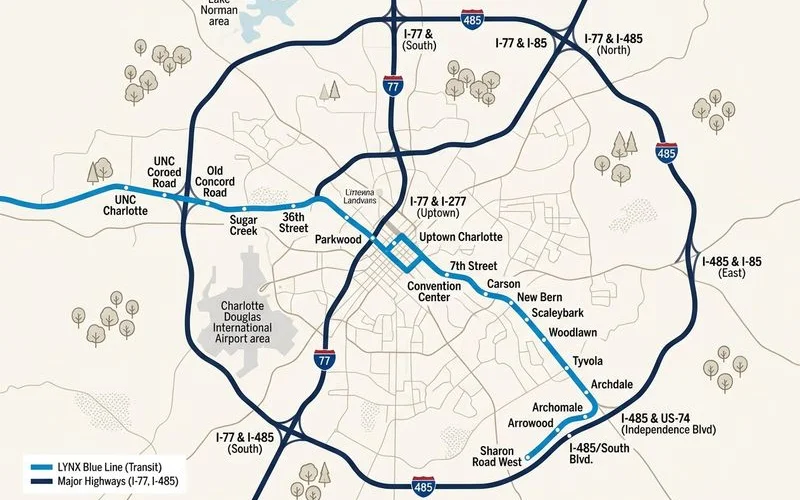
We often describe I-485 as the vital 67-mile outer beltway that circles the entire city. This highway is the primary connector for the suburban-to-Uptown commute when I-77 or Independence Boulevard is the inner-corridor option. Major choke points consistently concentrate at the I-77 interchange, the Highway 16 junction, and the Independence Boulevard interchange.
Our observation is that most homeowners use I-485 primarily as a weekend-and-errand route rather than a daily path. A major exception applies to south Charlotte professionals in Ballantyne and Pineville. These commuters rely on it heavily to reach east-side employer clusters.
We want to highlight a massive recent change for southern Mecklenburg County drivers. The long-awaited I-485 Express Lanes officially opened in late February 2026. This 18-mile toll addition stretches from I-77 to U.S. 74.
- No HOV Discounts: Unlike I-77, free high-occupancy vehicle travel is not allowed on this loop.
- Future Pricing: Dynamic pricing will begin after the first year of operation.
- Speed Minimums: Rates will fluctuate to maintain a minimum speed of 45 miles per hour.
- Exemptions: Transit vehicles and registered first responders ride for free.
Our team highly recommends grabbing that NC Quick Pass to avoid paying double rates on this new stretch. Commuters finally have a reliable option to bypass the daily southern loop gridlock. The time savings alone can be worth the daily cost.
Independence Boulevard / I-74 east corridor
We track major infrastructure updates, and Independence Boulevard (US-74) remains a massive focal point. This heavily commercial corridor runs east and west, connecting Matthews and Mint Hill directly to Uptown. The daily reality brings predictable but slow travel times of 25 to 40 minutes from Matthews during peak hours.
We find that our reverse commute clients handle this route much easier. Most professional cluster employers in Matthews hire from across the metro area, which helps distribute the traffic load. The entire stretch is undergoing a monumental multi-year freeway conversion project.
We have reviewed the North Carolina Department of Transportation plans for the upcoming phases. A $900 million widening project is projected to break ground in 2027. Future designs will eventually remove traffic signals out toward I-485 and replace them with bridge overpasses.
- Lane Additions: A new express toll lane will be added in each direction.
- Free Options: Three general-purpose lanes will remain open and free.
- Intersection Upgrades: Bottlenecks like Idlewild Road and Sam Newell Road will see major bridge improvements.
We know that five years of impending construction will cause headaches for local business owners. The long-term payoff will be a massive reduction in daily congestion. Until then, budget extra time if your office sits anywhere along the US-74 corridor.
The LYNX Blue Line
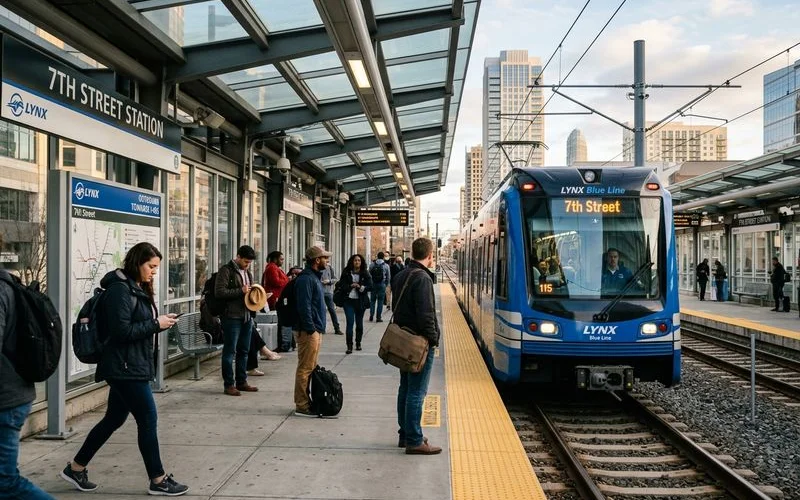
Our transit-focused buyers prioritize the LYNX Blue Line above all other options. This is Charlotte’s single operational light rail line. The tracks run 19 miles from the UNC Charlotte northern terminus straight through Uptown to the I-485 South station.
We constantly reference these standard travel times to help clients plan their mornings.
| Route Segment | Estimated Travel Time |
|---|---|
| South End to Uptown | 10 to 15 minutes |
| Uptown to UNC Charlotte | 25 to 30 minutes |
| South End to UNC Charlotte | 35 to 45 minutes |
| Complete End-to-End Trip | ~50 minutes |
Weekday peak headways run every 7 to 8 minutes. Off-peak service drops to 15 or 20 minutes, with trains running roughly from 5 AM to midnight.
We closely monitor ridership statistics to gauge neighborhood popularity. The system averages over 27,000 passenger trips on a typical weekday. The Charlotte Area Transit System recently increased security budgets by 50% for 2026 to ensure passenger safety.
We tell anyone working Uptown that living near the lynx blue line stations makes a transit-only lifestyle totally viable. Corridor neighborhoods like South End, parts of NoDa, and University City are the most realistic options. For more on the car-free question specifically, see our walkable Charlotte guide.
The Gold Line streetcar
We consider the Gold Line streetcar a helpful neighborhood connector rather than a primary commuting tool. This route runs limited service from the Charlotte Transportation Center east through Plaza Midwood toward Eastland. The four-mile route is shorter and operates at a lower frequency than the Blue Line.
We notice our clients rarely rely on it to get to their corporate offices on time. Headways sit at about 20 minutes between trains. It remains a great asset for running local errands or reaching Novant Health appointments without parking a car.
Charlotte commute guide: Where to live based on your commute
We match specific neighborhoods to employment hubs every single day. Choosing the right zip code based on your office location is the easiest way to improve your quality of life. A short physical distance on a map can easily translate to 45 minutes in reality if you pick the wrong route.
Transit-Only Uptown Commutes
We point transit lovers directly toward South End, the NoDa core, Uptown’s 4th Ward, or University City. You need to live within walking distance of the Blue Line stations for this to work. South End remains the highest-density and highest-walkability option on the market.
Driving to Uptown
We know that many professionals prefer the privacy of their own vehicle. If you work Uptown and are okay driving, most of Charlotte works just fine. Plaza Midwood, Dilworth, Myers Park, and the south-suburb corridors like Ballantyne all run 15 to 30 minutes off-peak.
We strongly advise adding 10 to 20 minutes to that estimate during the morning rush. The traffic builds quickly on major arteries. Plan your departure times accordingly.
South Suburbs and University City
We apply a completely different strategy for employment centers located outside of Uptown. If you work in Ballantyne Corporate Park or Pineville, living in the south suburbs themselves makes the most sense. The reverse commute from Uptown is workable but adds 25 to 30 minutes each way.
We advise professionals stationed at University Research Park near TIAA or Wells Fargo to look closely at University City. The northern Blue Line corridor offers fantastic housing options for this specific commute. Dilworth is the absolute closest residential match for Atrium Health staff.
Healthcare Workers at Atrium Health
We help many doctors and nurses find housing near this specific Carolinas Medical Center campus. Myers Park, South End, and Plaza Midwood are all highly convenient options. These neighborhoods sit just 10 to 15 minutes away by car.
Reverse commutes are real
We believe the single most overlooked strategy in the city is the reverse commute. Most peak-hour traffic pain involves suburbs-to-Uptown in the morning and Uptown-to-suburbs in the evening. A job in Ballantyne, University Research Park, or Lake Norman completely flips that script.
We watch clients breeze down the highway at near free-flow speeds for most of the day. Living centrally while working in Ballantyne or Lake Norman creates incredible lifestyle wins.
A reverse commute from a central neighborhood to a suburban office can easily save a driver over 150 hours a year behind the wheel.
We calculate that this time-of-day inversion pays off massively. It is not for everyone, but the math is impossible to ignore. Lower stress levels and more free time are highly compelling reasons to try it.
Airport access
We constantly field questions about getting to Charlotte Douglas International Airport. This hub is massive, handling a record-breaking 58.8 million travelers in 2025. The facility now ranks as the sixth busiest airport in the entire world for takeoffs and landings.
We remind frequent flyers that CLT is roughly 15 to 25 minutes from Uptown by car. Rideshare is the standard local option because the Blue Line does not reach the airport. The ongoing Terminal Lobby Expansion project makes arriving early more important than ever.
- West End: Offers the absolute fastest access via Wilkinson Boulevard.
- South End: Provides a quick trip using Billy Graham Parkway.
- Uptown: Features very direct highway routes straight to the terminals.
We tell clients looking at east-side neighborhoods like Plaza Midwood or NoDa to expect longer travel times. Those trips require taking I-77 or I-485 and usually take 25 to 35 minutes. If frequent flying is a core part of your business, you must factor airport drive time into your final neighborhood decision.
We highly recommend you review this charlotte commute guide before signing your next lease. Reach out to our team to ensure your home base supports your travel schedule. Your daily quality of life depends on making the right choice.
Common questions
How bad is the I-77 commute from Lake Norman to Uptown?
Does the LYNX Blue Line reach the airport?
Are reverse commutes easier in Charlotte?
Related guides
Best Time of Year to Move to Charlotte
Charlotte's seasonal weather, school calendars, and rental peaks. When to time your move for the best inventory and weather.
Charlotte Climate, Weather, and Seasonal Lifestyle
Charlotte's year-round climate, humidity, seasonal events, and outdoor rhythm. What to expect after a Northern move.
Charlotte vs. Raleigh: Which North Carolina City Fits You?
Charlotte vs Raleigh for relocators: industry mix, cost, climate, commute, lifestyle fit. Honest head-to-head comparison.
Cost of Living in Charlotte vs. Other Cities (2026 Guide)
Charlotte cost of living compared to NYC, LA, SF, Chicago, DC. Real housing, tax, and salary equivalence numbers for relocators.
Ready to make Charlotte feel like home?
Free relocation match, typically same-week reply.