How Charlotte's Cost of Living Compares to Major US Cities
Charlotte cost of living compared to NYC, LA, SF, Chicago, DC. Real housing, tax, and salary equivalence numbers for relocators.

Why the cost of living in charlotte comparison matters for relocators
You know how the average charlotte cost calculator never seems to capture the actual monthly cash flow of a relocation? We hear this frustration constantly from business owners assessing the charlotte vs nyc cost differences, as well as professionals moving from Los Angeles, San Francisco, Chicago, and Washington DC. The headline rent difference is frankly only half the story.
Our home buyer services clients quickly discover that state income taxes, property assessments, and local utilities drive the real financial shift. For instance, understanding the true cost of living in charlotte starts with swapping a $3,400 Brooklyn one-bedroom for a $2,400 luxury unit in South End.
We are going to break down the honest, neighborhood-specific math for these five major coastal markets.
The following analysis details the true housing comparisons, the unexpected local expenses, and the actual salary equivalents required to maintain your lifestyle.
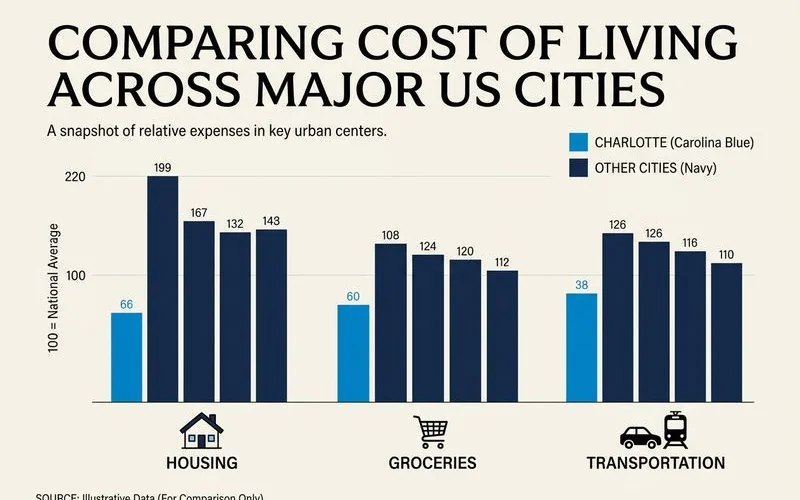
The fastest way to read this comparison
Look at three numbers: housing (rent or median price), state income tax, and property tax. Those three drive 70% of the total-cost difference for most relocators.
Where Charlotte beats the major coastal cities
We consistently see that housing is the undeniable headline for anyone moving to North Carolina. Median rent and home prices run roughly 30% to 50% lower than San Francisco, Los Angeles, New York, and Washington DC.
Our team tracks the local market closely, noting that the median home price in Charlotte reached approximately $412,500 in May 2026 according to Canopy MLS data. Neighborhood selection plays a massive role in your final budget.
We routinely see two-bedroom apartments in premium areas like South End and Uptown commanding $2,500 to $3,200 a month. Conversely, neighborhoods like NoDa, Plaza Midwood, and University City offer ample inventory in the $1,400 to $2,000 range, with University City featuring single-family homes often priced under $300,000.

| Category | Charlotte | NYC | LA | Chicago | DC |
|---|---|---|---|---|---|
| Median 1BR rent | $1,650 | $3,500 | $2,650 | $2,000 | $2,400 |
| Median home price | $412k | $760k | $930k | $370k | $620k |
| State income tax (top) | 3.99% | 10.9% | 13.3% | 4.95% | 10.75% |
| Effective property tax | 0.77% | 1.92% | 0.65% | 2.30% | 0.55% |
| Total COL index | 96 | 168 | 152 | 105 | 140 |
Tax Advantages for Transplants
Our clients moving from California, New York, New Jersey, or Illinois experience immediate relief when they see the local tax structure. North Carolina implemented a flat 3.99% state income tax for 2026, which replaces the heavy progressive brackets of all five comparison markets.
We always highlight that this rate is scheduled to drop even further to 3.49% by 2027. Property taxes provide another massive financial win for relocating homeowners.
Our records show the 2026 combined Charlotte and Mecklenburg County effective property tax rate sits at just 0.77%. A buyer purchasing a $2.5 million luxury home in a neighborhood like Eastover will pay roughly $19,170 annually, saving tens of thousands compared to the $45,000 bill typical for a similar property in Westchester County, New York.
We also direct buyers to the South Carolina border markets like Fort Mill and Tega Cay, where property taxes drop even lower.
Where Charlotte costs more (be honest)
Cost comparisons often gloss over the localized expenses that catch new residents entirely off guard. We make it a priority to warn clients about the annual vehicle property tax.
While standard auto insurance premiums in North Carolina are quite affordable, averaging just $1,412 annually according to 2026 A-MAX Insurance data, the state levies a yearly property tax on your car. Our relocated clients from New Jersey or California are frequently surprised to pay a 3% Highway Use Tax upon titling their vehicle, followed by an annual tax based on the car’s appraised value.
Summer utilities represent another budget category requiring immediate adjustment. We see power bills spike significantly during the intense July and August humidity.
A typical residential customer using 1,000 kilowatt-hours pays Duke Energy about $135 to $144 per month, but heavy air conditioning use routinely pushes consumption far beyond that baseline. Our advice is to budget an extra $100 to $150 monthly during peak summer months to cover this sustained HVAC usage.
Managing Groceries and Daily Expenses
Daily household expenses present a mixed bag compared to dense urban environments. We often hear from clients that specialty grocery items and organic produce run slightly higher here than in major coastal cities where fierce supermarket competition drives down prices.
A trip to a local specialty market will likely cost you more than the equivalent errand in Los Angeles. Our team loves pointing out the bright side, which is the incredibly strong and affordable local dining scene.
Eating out at highly-rated restaurants in Charlotte is meaningfully cheaper than dining in San Francisco or Manhattan.
Salary equivalence: how to read your number
We answer the exact same question for almost every professional considering this move: “What does my current salary buy in North Carolina?” The honest answer depends entirely on your origin city and whether you are buying a home or renting commercial space for a business.
Our baseline metric is that your purchasing power expands drastically, but the exact multiplier varies. Here is a realistic breakdown of how your current gross income translates to the cost of living in charlotte:
- New York to Charlotte: Roughly 65% to 75% of your New York gross income gets you the exact same lifestyle. Business owners relocating commercial operations see even greater margins due to reduced office leasing rates.
- Los Angeles to Charlotte: You need about 70% to 80% of your Los Angeles salary. The massive savings stem primarily from housing equity, rather than just the income tax differences.
- San Francisco to Charlotte: Plan for 60% to 70% of your San Francisco gross. This extreme delta is almost entirely driven by the staggering cost of Bay Area real estate versus local Carolina pricing.
- Chicago to Charlotte: Expect an 85% to 95% equivalence. These two markets are much closer financially than most relocators realize, but the 2026 property tax differences remain the ultimate swing factor.
- Washington DC to Charlotte: Budget for 70% to 80% of your District income. You will notice the biggest relief in housing costs and the absence of steep progressive state income taxes.
We have these exact salary translation conversations with clients every single week. A generic online calculator simply cannot account for your specific neighborhood preferences, family size, or business overhead.
Our team is ready to walk through your unique financial numbers on a short, zero-pressure phone call.
Reaching out today ensures you get a real, customized comparison before making any major relocation decisions.
Common questions
Is Charlotte really cheaper than NYC?
Where does Charlotte actually cost more?
Does North Carolina have lower taxes than New York?
Related guides
Best Time of Year to Move to Charlotte
Charlotte's seasonal weather, school calendars, and rental peaks. When to time your move for the best inventory and weather.
Charlotte Climate, Weather, and Seasonal Lifestyle
Charlotte's year-round climate, humidity, seasonal events, and outdoor rhythm. What to expect after a Northern move.
Charlotte Commute Guide: I-77, I-485, and the LYNX Blue Line
Real Charlotte commute reality on I-77, I-485, the toll lanes, and the LYNX Blue Line. Where to live based on commute, not zip code.
Charlotte vs. Raleigh: Which North Carolina City Fits You?
Charlotte vs Raleigh for relocators: industry mix, cost, climate, commute, lifestyle fit. Honest head-to-head comparison.
Ready to make Charlotte feel like home?
Free relocation match, typically same-week reply.