When to Move to Charlotte (And When to Avoid)
Charlotte's seasonal weather, school calendars, and rental peaks. When to time your move for the best inventory and weather.

We talk to hundreds of professionals relocating each year, and the same question always surfaces. Figuring out the best time to move to Charlotte depends entirely on what you prioritize.
The honest answer changes whether you want peak housing inventory, perfect weather, or the lowest rent prices. Let’s lay out exactly how these seasonal windows overlap in 2026.
This guide breaks down each specific calendar constraint to help you plan a smarter transition.
The fastest read of this guide
Best inventory and worst weather: July-August. Best weather and decent inventory: April-May or September-October. Best concessions and lowest competition: November-January. School-family sweet spot: late June through mid-July.
Weather windows worth knowing
The ideal weather for moving falls during the Spring (mid-March through May) or Fall (September through November) seasons. Moving outside these windows requires specific preparation for extreme heat or occasional ice.
Spring brings daytime highs of 65 to 78 degrees before the intense humidity arrives. Summer changes the game completely.
Highs routinely hit 88 to 92 degrees between June and August. Afternoon thunderstorms also become a daily threat. These storms often carry fast straight-line winds moving at 40 to 60 miles per hour.
Our team always recommends booking your moving truck for an early morning arrival during the summer. This avoids the afternoon storm peak and the worst of the midday heat.
If you must load a truck in the rain, wrap wood furniture in moving blankets and then cover them in plastic sheeting. Plastic wrap alone creates condensation damage in Charlotte’s high humidity.
Fall offers crisp mornings and low humidity, making it the second-best weather window. Winter remains mild by northern standards with highs in the 50s. Snow is rare, averaging just one to four inches annually, but occasional ice events can delay transit.
Key Seasonal Moving Hazards to Avoid:
- Summer Afternoons: Fast-moving thunderstorms peak between 3:00 PM and 6:00 PM.
- Spring Showers: Heavy April rains require waterproof barriers over electronics.
- Winter Mornings: Early morning frost in January can make loading ramps dangerous.
Rental market timing
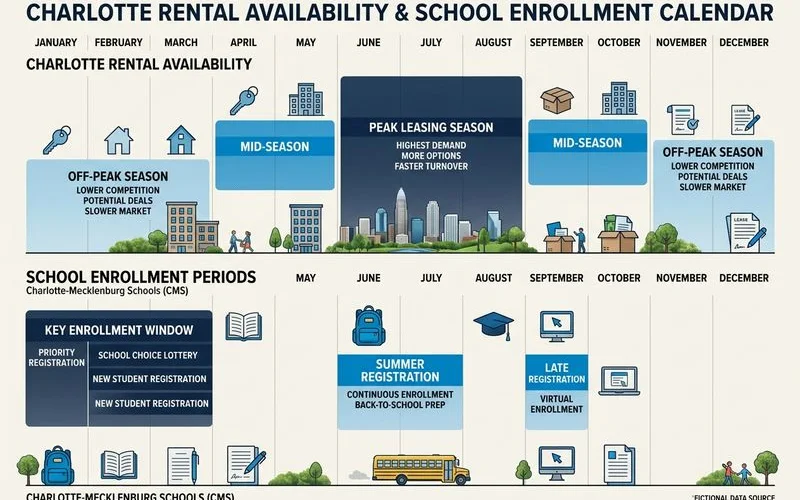
You will find the highest apartment inventory from mid-May through August, while the best financial deals appear between November and January. The changing supply pipeline directly affects your options and pricing.
Charlotte experienced a massive wave of new apartment construction in 2024, pushing over 16,000 new units into the market. This surge created high vacancy rates and forced properties to offer massive concessions into early 2025.
Now in 2026, new unit completions have dropped by nearly 30 percent. Landlords are pulling back on those aggressive “one month free” offers as the local housing supply tightens.
The average effective rent for an apartment is currently settling around $1,620 per month. If you want a single-family rental home, expect average monthly costs closer to $2,000 with properties sitting on the market for only about three weeks.
Most of our apartment locating clients with flexible timelines target the shoulder seasons of September to October or February to April. This strategy balances decent inventory with lower competition.
| Moving Window | Inventory Level | Concession Likelihood |
|---|---|---|
| May - August | Peak (Highest Options) | Low (High Competition) |
| September - October | Moderate (Balanced) | Medium (Rising Promos) |
| November - January | Low (Fewest Options) | High (Best Deals) |
Properties often waive deposits or offer gift cards instead of lowering the base face rent during the slower months. We strongly advise focusing on that net effective rate to secure the best overall value.
School-family timing
Families and homeowners with school-aged children should aim to arrive in late June or mid-July. This provides a four to six-week buffer to handle enrollment and residency verification before classes begin.
The Charlotte-Mecklenburg Schools (CMS) district consistently schedules a late-August start date. For the 2026 to 2027 academic year, the first day of school lands on Tuesday, August 25. Planning an early summer arrival gives your children time to see their new building and adjust before the chaos starts.
Neighboring districts operate on slightly different timelines. The Fort Mill and Tega Cay border districts in South Carolina typically start a full week earlier than CMS in most years.
Mid-year relocations require precision and careful planning around holiday closures. The CMS calendar includes a 14-day winter break that generally begins around December 20.
Important School Relocation Milestones:
- 6 Weeks Out: Gather original birth certificates and immunization records.
- 4 Weeks Out: Finalize your lease or closing documents to prove residency.
- 2 Weeks Out: Register for before-and-after-school care programs.
Non-school-aged households have much more freedom. October is a fantastic sweet spot for these families since the summer humidity is gone and rental concessions start to increase.
Job-start timing for transferees
Corporate transferees and business owners must work backward six to eight weeks from their fixed start date to secure local housing. You need an organized timeline to coordinate logistics with professional moving companies.
Peak summer relocations between May and September see intense national demand. Booking a long-distance mover requires up to eight weeks of lead time during these busy months. If your employer provides a relocation package, use a one or two-week temporary housing buffer to ease the transition.
Moving during the off-peak season from October through April offers significantly more flexibility. Local and regional movers often only require three to four weeks of notice during this period.
We routinely sequence housing decisions around difficult start dates that fall outside peak inventory windows. A midweek move on a Tuesday or Wednesday gives you the best chance of securing a top-rated crew. Weekend dates and end-of-month slots fill up instantly due to standard lease cycles.
Professional Relocation Tip: Never book your moving truck for the exact day your lease begins. Give yourself a 24-hour buffer to handle property inspections, collect keys, and verify the HVAC is functioning properly before the heavy lifting starts.
What to do if your timing is fixed
When your timeline lacks flexibility, you must start the search much earlier than feels natural. Early preparation prevents panic and secures better pricing.
Securing a peak summer move requires initiating the process 60 to 90 days before your target date. Waiting until the last minute drastically reduces your options and increases logistical costs. Average local same-day or emergency moving services in Charlotte can easily exceed $1,300.
Winter moves offer a bit more grace and breathing room. A 30-day window is often workable in December or January because inventory rotates slowly. Property managers frequently hold off-market units for committed renters during these quiet months.
Fixed-Timeline Essentials:
- Secure Movers First: Lock in your transportation before finding the perfect house.
- Expand Your Radius: Look at neighboring ZIP codes to increase your options.
- Prepare Finances: Have security deposits and admin fees ready to transfer instantly.
Lifestyle-first matching always beats applying to the first available property. We recommend having a short, honest conversation about your must-haves and deal-breakers early in the process. Establishing these priorities shapes a highly targeted shortlist that saves you time, money, and stress.
Common questions
When is Charlotte rental inventory at its highest?
Is summer too humid to move to Charlotte?
When do Charlotte-Mecklenburg Schools start?
Related guides
Charlotte Climate, Weather, and Seasonal Lifestyle
Charlotte's year-round climate, humidity, seasonal events, and outdoor rhythm. What to expect after a Northern move.
Charlotte Commute Guide: I-77, I-485, and the LYNX Blue Line
Real Charlotte commute reality on I-77, I-485, the toll lanes, and the LYNX Blue Line. Where to live based on commute, not zip code.
Charlotte vs. Raleigh: Which North Carolina City Fits You?
Charlotte vs Raleigh for relocators: industry mix, cost, climate, commute, lifestyle fit. Honest head-to-head comparison.
Cost of Living in Charlotte vs. Other Cities (2026 Guide)
Charlotte cost of living compared to NYC, LA, SF, Chicago, DC. Real housing, tax, and salary equivalence numbers for relocators.
Ready to make Charlotte feel like home?
Free relocation match, typically same-week reply.