Northeast to Charlotte Relocation: An Honest Guide
Northeast to Charlotte: climate transition, transit reset, suburban options, tax savings, and where NJ-style families land.

Why relocators choose moving to charlotte from new york
We track housing data daily, and the migration pattern of people moving to charlotte from new york, New Jersey, or Massachusetts is the largest single trend right now. Housing affordability, significant tax savings, and a milder four-season climate are the primary reasons these buyers head south.
This specific nyc to charlotte corridor is driven by business owners and homeowners seeking a better cost of living.
The transition involves a specific set of adjustments.
Our team consistently hears that Northeast transplants miss walkable density and rapid transit far more than any specific weather pattern. Let’s break down the exact lifestyle shifts, real estate realities, and financial differences you need to prepare for.
Climate transition
The immediate benefit of leaving the northeast is escaping those brutal, multi-foot snowstorms. Charlotte’s winter is vastly milder, with daily highs comfortably resting between 45 and 55 degrees Fahrenheit.
Our clients appreciate that annual snowfall barely reaches two inches, keeping roads clear and businesses open year-round. The undeniable trade-off arrives during the intense summer months.
July and August bring a fierce combination of heat and moisture that requires a real physical adjustment. We always warn newcomers about the muggy factor when dewpoints rise above 65 degrees. You will quickly learn to schedule outdoor activities for the early morning to avoid the peak heat.
Here is what a typical Charlotte summer actually looks like:
- Peak Temperatures: Daily highs regularly reach 90 to 96 degrees by mid-July.
- High Humidity: August is the muggiest month, with average relative humidity hovering around 74 percent.
- Afternoon Storms: Quick, heavy thunderstorms are a daily reality that often clear the air before evening.
Spring repays that summer intensity with a spectacular show of citywide dogwood blooms by late March. If you appreciate a long, comfortable autumn season, the extended October weather in North Carolina will absolutely win you over.

The transit reset
Public transportation is the single biggest lifestyle adjustment for anyone relocating from cities like New York or Boston. Charlotte operates the LYNX Blue Line, a 19-mile light rail asset carrying over 27,000 weekday riders from UNC Charlotte through Uptown down to I-485 South, but it cannot replace a comprehensive subway network.
We see many former commuters struggle with the realization that a sprawling bus system simply does not match MTA expectations. You will likely need to purchase a car unless you strategically choose your neighborhood.
Our preferred strategy for transit-reliant buyers is focusing exclusively on areas directly bordering the light rail. Living within walking distance of a Blue Line station allows for a functional car-light lifestyle.
The most realistic neighborhoods for this approach are:
- South End: Highly walkable with immediate access to multiple rail stations.
- Uptown: The central business district where the rail lines converge.
- NoDa Core: A localized arts district with its own dedicated rail stops.
- University City: The northern terminus of the $1.16 billion rail extension.
The traditional New Jersey or Connecticut commuter model simply does not exist here. We remind clients that driving to a park-and-ride station works for some. The sprawling nature of the surrounding region means your vehicle will become a daily necessity.
Density expectations: Charlotte is not NYC
Be honest with your expectations before you arrive, because even Charlotte’s busiest districts are nowhere near Manhattan density levels. New York City packs over 28,000 people into a single square mile, while Charlotte averages closer to 3,100 residents in that same space.
We love the breathing room this creates, but it means fewer surprise discoveries during a casual evening walk. The primary benefit is securing significantly more square footage and private outdoor space for your housing dollar.
Our team often watches transplants search in vain for a localized Greenwich Village equivalent. You must recalibrate your urban compass to appreciate the unique neighborhood rhythms found down south.
If you are comparing specific areas, these are the closest matches:
- Plaza Midwood: This area shares the residential-meets-commercial vibe of Park Slope, leaning heavily to quiet side streets.
- NoDa: The historic arts district mirrors the gritty energy of the Lower East Side, but operates with about one-third of the pedestrian foot traffic.
- South End: The density here feels remarkably similar to the young Brooklyn waterfront circa 2010.
Embracing this lower density is the key to enjoying your new environment. We recommend shifting your focus from street-corner convenience to neighborhood breweries, expanded patios, and larger residential footprints.
Suburban options for NJ and CT commuter habits
If you previously relied on a structured New Jersey or Connecticut commuter town, several local suburbs can replicate that community feel without the grueling train ride. The northern and southern borders of Charlotte offer exceptional schools, distinct town centers, and mature residential developments.
Our real estate professionals frequently direct families to these specific markets to ease the transition. You will find that these suburbs trade the daily train commute for a 20 to 30-minute highway drive into Uptown.
We highlight these four primary destinations for buyers seeking top-tier education and a walkable core:
Top Northern Suburbs
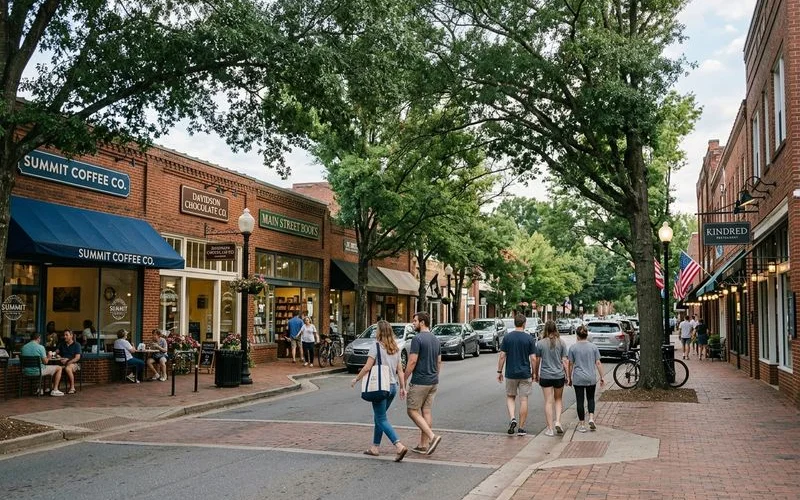
- Davidson (20-25 min north): A classic college town anchored by a highly walkable Main Street and mature trees. The median home price here sits around $582,000 as of 2026, offering strong value for the premium location.
- Huntersville (25-30 min north): Known for the Birkdale Village retail core and immediate access to Lake Norman. Homes in this highly desired CMS school zone currently sell for a median of $628,000.
Top Southern and Eastern Suburbs
- Matthews (20-25 min southeast): Features a thriving, historic downtown Main Street and community hubs like Stumptown Park.
- Fort Mill, SC (25-30 min south): Anchored by the Baxter Village town center, this market provides access to top-rated South Carolina schools and much lower property tax burdens.
These specific areas represent the core markets we cover for home buyer services clients with school-aged children.
Tax savings: where the money actually goes
Financial relief is the strongest catalyst for leaving the northeast, driven primarily by a massive reduction in annual tax liabilities. North Carolina transitioned to a flat individual income tax rate that dropped to an incredibly competitive 3.99 percent for the 2026 tax year.
We constantly run the numbers for business owners, and this flat structure completely replaces the punishing progressive brackets found in New York, New Jersey, and Massachusetts. A household earning $200,000 typically retains an extra $8,000 to $15,000 annually just from state income tax savings alone.
Our financial analysis always points to property taxes as the second major wealth builder. Mecklenburg County charges an effective property tax rate of roughly 0.85 percent, which feels negligible compared to the 2 to 3 percent effective rates common across the northern suburban belt.
We advise families with location flexibility to look closely at South Carolina border towns. The financial benefits of crossing the state line break down like this:
- Income Tax Variations: South Carolina uses a different bracket system, but the property tax relief often offsets any differences.
- Fort Mill and Tega Cay: These specific South Carolina municipalities run much lower property tax rates than their North Carolina neighbors.
- Long-Term Savings: Funneling those combined savings into investments or local business ventures explains why so many successful northern families thrive in our market.
Popular landing spots from NYC and Boston
Choosing the right initial neighborhood requires aligning your daily routine with the realities of southern urban design. Younger professionals and transit-focused buyers overwhelmingly choose to start their journey in South End or Uptown.
We typically see these urban transplants rent a luxury apartment for the first year to truly learn the city’s layout. This buffer period allows you to comfortably decide between committing to an urban condo or migrating outward to purchase a larger single-family property.
Where Families Settle
Our family-oriented clients take a distinctly different approach when heading south. Families prioritizing education and space land almost exclusively in Davidson, Huntersville, Fort Mill, or Tega Cay.
These specific suburbs deliver the elusive suburban-with-walkability character that loosely mirrors the premium northeast towns they left behind. You gain the massive yards and excellent school systems without feeling completely isolated from a community core.
If you are currently weighing this market against another major Sun Belt destination, our Charlotte vs. Raleigh comparison covers the most common head-to-head questions.
Your Next Steps
A successful relocation means looking beyond the real estate transaction. Moving to charlotte from new york requires careful planning, but the financial and lifestyle rewards are undeniable.
We specialize in matching your specific northern living preferences to the perfect southern neighborhood.
Reach out to schedule a consultation today, and let’s start building your relocation strategy.
Common questions
Is Charlotte big enough after living in NYC?
Can I survive in Charlotte without a car?
How much do I save in taxes leaving NJ?
Related guides
Best Time of Year to Move to Charlotte
Charlotte's seasonal weather, school calendars, and rental peaks. When to time your move for the best inventory and weather.
Charlotte Climate, Weather, and Seasonal Lifestyle
Charlotte's year-round climate, humidity, seasonal events, and outdoor rhythm. What to expect after a Northern move.
Charlotte Commute Guide: I-77, I-485, and the LYNX Blue Line
Real Charlotte commute reality on I-77, I-485, the toll lanes, and the LYNX Blue Line. Where to live based on commute, not zip code.
Charlotte vs. Raleigh: Which North Carolina City Fits You?
Charlotte vs Raleigh for relocators: industry mix, cost, climate, commute, lifestyle fit. Honest head-to-head comparison.
Ready to make Charlotte feel like home?
Free relocation match, typically same-week reply.