How Long a Charlotte Apartment Search Actually Takes
Real Charlotte apartment search timeline: 2-4 week active search, 30-60 day lease windows, seasonal differences.
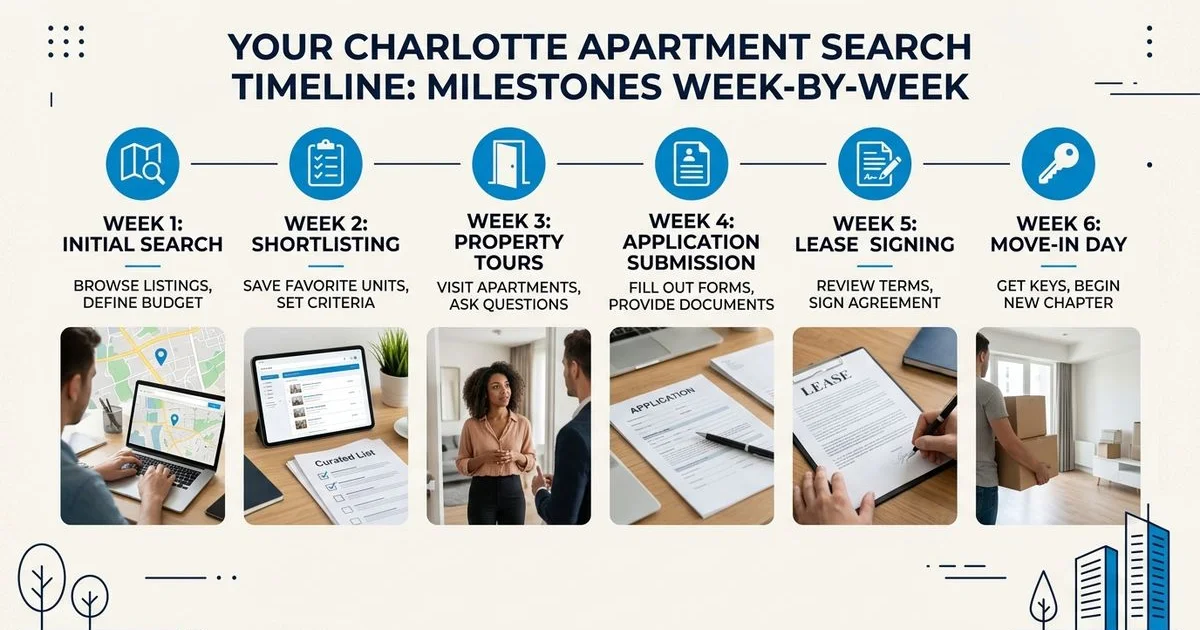
How long does charlotte apartment search take? What an honest timeline actually looks like
You know how frustrating it is to plan a relocation without a clear schedule.
If you are wondering how long does charlotte apartment search take, the answer requires looking at current data. Our team sees business owners and transitioning homeowners struggle with this exact timeline every season. The reality of the local market dictates a very specific approach.
Expect a 60-day window from your initial thought to holding the keys, with two to four weeks of active searching in the middle.
We track local supply data closely to eliminate the guesswork for our clients. Recent 2026 reports show the city added over 16,000 new units, pushing occupancy down to around 94 percent. This influx of inventory gives you a strong negotiating position, but the schedule rules still apply.
Let’s look at the numbers, decode what they actually mean for your move, and map out exactly how to proceed.
The 60-day standard arc
The standard 60-day search follows four distinct 15-day phases. A precise charlotte apartment hunting timeline moves you from initial research to a signed lease without rushing the process.
Our specialists use this exact framework to guide corporate relocations and transitioning homeowners. The schedule provides a clear roadmap for a stress-free move. To start, a discovery conversation with an expert in Apartment Locating establishes your baseline, and our Charlotte apartment income requirements primer is worth reading before you tour anything.
Let’s break down the typical phases to show you exactly what to expect.
| Phase | Days Out | Key Actions | 2026 Market Context |
|---|---|---|---|
| Pre-Search | 60 to 45 | Neighborhood education and budget check. Document deal-breakers. | Average rent is $1,659, but Class A corporate units top $2,400. |
| Shortlist Build | 45 to 30 | Property research. Build an initial 5 to 7 building shortlist. | Up to 40 percent of local properties offer big move-in specials. |
| Active Search | 30 to 15 | Schedule Matterport virtual tours or visits. Submit applications. | Application approvals require a 680 credit score for standard processing. |
| Lease & Move | 15 to 0 | Lease execution and deposits. Utility setup and address updates. | Finalize Duke Energy and Charlotte Water accounts two weeks prior. |
This arc works perfectly for the typical relocator. Faster is possible, but slower is sometimes necessary depending on your specific requirements.
Lease availability windows in Charlotte
Most Charlotte apartments release inventory 30 to 60 days out from the intended move-in date. A unit available on March 15 typically appears on the market between mid-January and mid-February.
Our data shows that this timing ties directly to local lease regulations. North Carolina standard leases require residents to give a 60-day notice before moving out. Property managers immediately list those upcoming vacancies on the open market.
If you are more than 90 days out from your target date, you are too early. The current inventory will already be leased by the time you arrive. The shortlist phase at that stage is about identifying which buildings to watch and what kind of unit to expect, rather than applying to specific units.
- Class A Luxury Buildings: Highly amenitized buildings in areas like South End or NoDa often hold select inventory for corporate applicants with shorter notice.
- Class B and Older Properties: These units strictly follow the 60-day notice cycle and rarely hold units vacant.
- New Construction Lease-Ups: Buildings actively under construction may pre-lease units 90 to 120 days in advance of their grand opening.
We monitor these release patterns to help clients strike at the exact right moment. Being early is just as problematic as being late.
How seasonality compresses or extends the search
Peak summer compresses the timeline because inventory turns over quickly, while winter extends the timeline by offering more options and negotiation power. The season dictates your required speed.
During the peak summer months from May through August, more applicants compete for units. A unit that would sit for two weeks in November might lease in three days in July. You must plan for rapid decision-making because corporate giants like Atrium Health and Bank of America execute their major hiring cycles during this window.
| Market Metric | Peak Summer (May to Aug) | Slow Winter (Nov to Jan) |
|---|---|---|
| Average Time on Market | 3 to 7 days | 14 to 21 days |
| Move-in Specials | Very rare | Common (often 4 to 6 weeks free) |
| Negotiation Power | Property manager holds the advantage | Renter holds the advantage |
Winter months from November through January slow the market down. Inventory turns over more slowly, and properties offer aggressive move-in specials to fill empty rooms. You can be choosier and negotiate harder, but you have fewer total options to compare against. Spring and fall sit right in the middle, offering decent inventory and a comfortable pace.
Our corporate housing partners heavily favor these winter moves. The savings generated from seasonal rent discounts easily offset the cost of professional movers.
What slows a search down
Pet logistics, specific unit requirements, and complex income verification are the three primary factors that stretch timelines beyond the standard arc. Each of these variables requires extra processing time.
Pet logistics and breed restrictions
Breed restrictions, size limits, and pet fees vary widely across the city. If you have a large dog or a restricted breed like a Pitbull or German Shepherd, you must plan for additional research time. Nearly 80 percent of corporate-managed buildings in Charlotte ban these breeds entirely.
You will also need to budget for average local fees, including a 300 dollar non-refundable deposit and 25 dollars in monthly pet rent. Finding an accommodating property severely narrows your options.
Specific unit needs
Searching for a highly specific layout extends the hunt. A high-floor view, a dual-master floor plan for roommates, or a specific washer-dryer setup restricts the available inventory.
This issue frequently impacts homeowners waiting on custom home construction in suburbs like Lake Norman. These clients often require short-term, six-month leases in luxury units. Since most buildings prioritize 12-month agreements, securing a short-term luxury rental takes considerably more time.
Income or credit edge cases
Non-traditional financial situations require extra rounds of documentation. This includes self-employed business owners, independent contractors, international applicants, or anyone rebuilding their credit.
If you fall into these categories, property managers will likely ask for two years of tax returns or three months of bank statements. These documents must prove deposits equal to three times the monthly rent.
We regularly help self-employed clients gather these specific financial documents before they even start touring. Getting ahead of the paperwork saves a full week of administrative processing.
What can speed it up
Flexibility on your location and total readiness to sign a lease will drastically compress the timeline. Expanding your options and preparing your paperwork are the best ways to accelerate the process.

Flexibility on the neighborhood is the biggest time saver. If you look at two corridors instead of one, you double your chances of finding a match immediately. Consider emerging areas like Wesley Heights or Optimist Park instead of strictly focusing on Uptown. Being flexible on the unit type, such as accepting a spacious one-bedroom instead of holding out for a two-bedroom, also speeds things up.
Our practice routinely executes 14-day to 21-day searches for corporate transferees using these exact principles. The math is simple: prepared documentation, a narrow shortlist, and a decisive choice result in a signed lease. If you have a fixed start date for a new business contract, this speed is essential.
- Expand your radius: Add a five-mile buffer to your preferred zip code.
- Pre-gather documents: Have your bank statements, pay stubs, and identification ready in a single digital folder.
- Tour decisively: If a unit meets 80 percent of your criteria, apply immediately before leaving the property.
- Target new construction: Newly completed buildings are highly motivated to fill units quickly and process applications faster.
When planning your move, understanding exactly how long does charlotte apartment search take gives you a massive advantage.
We highly recommend reviewing your budget and target neighborhoods today. Scheduling a quick consultation with our team will ensure your next move is completely organized.
Common questions
How early should I start my Charlotte apartment search?
Can I find a Charlotte apartment in just two weeks?
Related guides
Apartment Locator vs. DIY Zillow Search in Charlotte
When a Charlotte locator beats Zillow, when DIY is fine, and the listing-freshness gap that costs renters time.
Are Charlotte Apartment Locators Actually Free?
How Charlotte apartment locators get paid by property management, and why the service is genuinely free for renters.
Charlotte Apartment Income and Qualification Requirements
3x rent rule, credit thresholds, guarantor options, and self-employed and remote-income rules for Charlotte rental applications.
Charlotte Apartment Move-In Specials and Lease Incentives
Common Charlotte specials, net effective rent math, and when concessions signal a soft market versus a building problem.
Ready to explore Apartment Locating?
A short conversation gets you a curated, lifestyle-first match.