Apartment Locator vs Zillow: When Each Wins in Charlotte
When a Charlotte locator beats Zillow, when DIY is fine, and the listing-freshness gap that costs renters time.
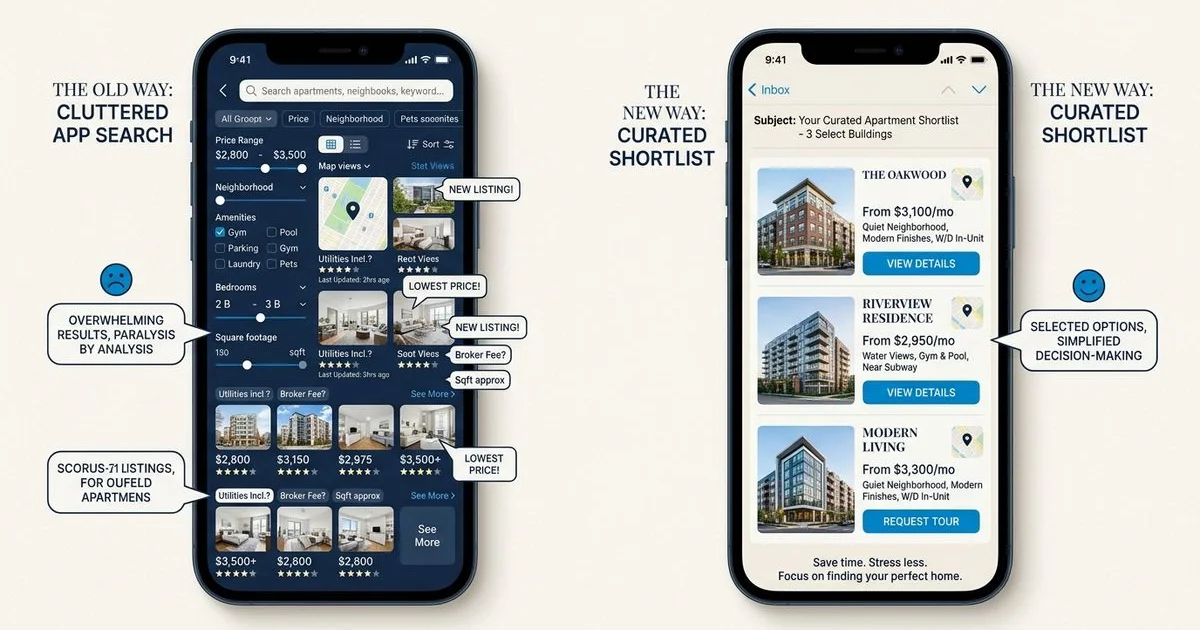
The honest comparison
You know how quickly the Charlotte housing market shifts, especially when you are managing a corporate relocation or transitioning between homes. When weighing an apartment locator vs Zillow Charlotte search, the choice simply comes down to how you value your time.
We are naturally biased since we operate an Apartment Locating practice, but this framework holds true regardless of the path you choose. For the underlying mechanics, see our breakdown of what a Charlotte apartment locator actually does.
The 2026 Charlotte vacancy rate is stabilizing around 6 to 8 percent. That means the best units still move fast.
Our team wants to give you an honest look at the numbers and trade-offs. Let’s examine the data so you can decide the smartest approach for your next move.
When DIY Zillow search works fine
Zillow and DIY searching work perfectly well if you already know the city, have flexible timing, and want a standard floor plan. This route is entirely reasonable for local renters who have done their homework.
If you meet the criteria below, you probably do not need professional help:
- You have lived in Charlotte before and understand the distinct vibe of corridors like South End, NoDa, or Plaza Midwood.
- You know exactly which one or two buildings you want, and they show current availability on their main website.
- Your move-in timeline is flexible, allowing you to wait weeks for a specific unit to open up.
- Your needs are mainstream, like a standard one-bedroom with an average 2026 rent around $1,470, and you have no unusual pets.
- You genuinely enjoy spending 5 to 15 hours running the search process yourself.
We find that tools like Zillow, RentCafe, and Apartments.com provide excellent baseline data for these straightforward searches. Public portals give you everything from basic photos and pricing to direct application links. Renters who have strong local context can successfully manage the entire process on their own.
Where Zillow gets you in trouble
Public real estate portals cause problems when you need real-time accuracy, access to hidden inventory, or specific lifestyle matching. Three common failure modes trap renters who rely exclusively on a DIY search.
The Listing Freshness Gap
We see Zillow listings routinely run one to three days behind actual availability at major Charlotte properties. By the time a nice unit pops up on your screen, the leasing office has likely already received three to five applications. Charlotte application fees average $75 per adult in 2026. Applying for a unit that is already spoken for just wastes your money and damages your credit score.
Hidden Off-Market Inventory
Property management groups often release their best inventory to leasing office referral channels before the public ever sees it. These channels include brokers, locator services, and corporate relocation programs. Our data shows that relying only on public websites means missing out on 10 to 30 percent of the available units in any given month.
The Lifestyle Filter Blind Spot
Standard search filters only cover basic metrics like price, bed count, and standard pet policies. None of those dropdown menus explain the weekend noise levels, the true walkability beyond a basic score, or the building’s current management reputation.
Consider the reality of living in South End near the LYNX Blue Line. A public listing will not warn a newcomer about the train noise rattling the windows of a specific floor plan. Relocators landing in Charlotte without this local context routinely sign leases at the wrong building.
When a locator wins
Professional locator services deliver the highest return on investment for out-of-state relocators, busy professionals, and renters with highly specific needs.
Out-of-State Relocators
Moving from another state means you lack local context, in-person tour bandwidth, and the time to learn different corridors. We know that corporate transfers driving the Charlotte economy, like those coming in for Bank of America or the new Scout Motors headquarters, need immediate clarity. A locator fills this gap by acting as your eyes and ears on the ground.
Time-Constrained Professionals
Corporate transferees, dual-career couples, and business owners coordinating school transitions rarely have spare time. The 10 to 20 hours saved by outsourcing the apartment search translates directly into less stress.
Renters with Specific Needs
Finding a place that accepts large dog breeds or specific accessibility requirements takes hours of tedious phone calls. Charlotte properties routinely charge a $400 upfront pet administration fee, and many restrict breeds like German Shepherds entirely. Our locators handle all of that filtering so you only tour places that actually approve your specific situation.
Comparing Your Search Options
The choice becomes much clearer when you look at the raw numbers.
| Feature | DIY Zillow Search | Professional Locator |
|---|---|---|
| Time Investment | 5 to 15 hours | 1 to 2 hours |
| Inventory Access | Public listings only | Includes pre-market units |
| Average Cost | Free (plus wasted app fees) | Free to the renter |
| Best For | Locals with flexible timelines | Relocators and busy professionals |
For these specific profiles, the math makes perfect sense. Hiring a professional is the best way to find a Charlotte apartment rental without the hassle. Everyone else can usually get by with a DIY or hybrid approach.
The hybrid approach
The smartest strategy for returning renters is to use public portals for neighborhood research and a locator to actually close the deal. Some Charlotte renters successfully blend both methods to get the best results.
What this hybrid pattern looks like in practice:
- Spend a few hours on Zillow around 60 days out to understand current price ranges.
- Tour one or two buildings in established areas like Ballantyne or SouthPark on your own to calibrate your expectations.
- Bring in a locator at the 30-day mark to curate a final shortlist and handle the actual application logistics.
We see this pattern work exceptionally well for business owners and homeowners who need temporary housing while waiting for a build to finish. They possess enough local familiarity to handle the early research phase. A professional then steps in to secure the lease without wasting any more of their valuable time.
What we tell renters who are deciding
The final decision requires you to weigh the value of your own time against the exclusive inventory access a professional provides. Ask yourself a simple question: do you value 10 to 20 hours of your schedule more than the lifestyle fit a locator brings?
For corporate relocators and business owners, the answer is almost always a resounding yes. The math is incredibly straightforward when you calculate your hourly worth against the cost of breaking a bad lease. We know that terminating a standard Charlotte lease often costs two full months of rent.
Local renters who already know the city might answer no, and that is perfectly fine. Our primary goal is to ensure you experience a successful search. A pushy sales pitch for a service you do not need helps no one.
We absolutely refuse to invent reasons for you to hire us. The honest answer is always the most useful one. Contact our office today if you decide that saving time and gaining market access is your top priority.
Common questions
When should I just use Zillow for my Charlotte apartment search?
Do locators see Charlotte apartments that are not on Zillow?
How much time does a Charlotte locator save?
Related guides
Are Charlotte Apartment Locators Actually Free?
How Charlotte apartment locators get paid by property management, and why the service is genuinely free for renters.
Charlotte Apartment Income and Qualification Requirements
3x rent rule, credit thresholds, guarantor options, and self-employed and remote-income rules for Charlotte rental applications.
Charlotte Apartment Move-In Specials and Lease Incentives
Common Charlotte specials, net effective rent math, and when concessions signal a soft market versus a building problem.
Charlotte Apartment Search Timeline: How Long It Really Takes
Real Charlotte apartment search timeline: 2-4 week active search, 30-60 day lease windows, seasonal differences.
Ready to explore Apartment Locating?
A short conversation gets you a curated, lifestyle-first match.