How Much You Need to Earn to Rent in Charlotte
3x rent rule, credit thresholds, guarantor options, and self-employed and remote-income rules for Charlotte rental applications.

How Charlotte property qualification actually works
We know how stressful the application process feels when you are looking for a new place, whether you are between homes or relocating employees. A simple misstep with documentation can delay your approval or cost you non-refundable fees.
Our team regularly helps homeowners and business owners prepare for these specific charlotte apartment income requirements, especially as standards evolve in 2026. The friction usually happens during the income verification stage, rather than the initial qualification check.
We use this guide to explain exactly what most local properties expect from you. The details vary slightly by property tier, but the core formula remains consistent across the city.
For broader context on the apartment search itself, read our Apartment Locating page.
The 3x-rent industry standard
We want you to know that the standard benchmark across the city is a gross household income of three times the monthly rent. As of May 2026, the average rent in Charlotte sits around $1,470 per month.
Our calculations show you will need an annual salary of approximately $53,000 to easily qualify for an average unit. Class A high-rises in South End and Uptown rarely negotiate on this rule.
We have seen some Class B properties drop their requirement to 2.5 times the rent. Companies like PURE Property Management sometimes accept this lower threshold if you have excellent credit.
Our team often helps clients manage borderline income situations with a few proven strategies. You have practical options to secure an approval even if your numbers fall short.
- Roommate Combination: Most properties allow up to three unrelated adults to combine their incomes.
- Guarantor Support: A co-signer can replace your income requirement, though they must usually prove they make five to six times the monthly rent.
- Alternative Deposits: Services like Obligo offer security deposit waivers for a small monthly fee, which can help if your upfront cash is tight.
Credit thresholds by property tier
We typically see the minimum credit score for Charlotte apartments hovering between 600 and 650. The exact requirement depends heavily on the specific tier of the building you choose.
Our experience shows that luxury high-rises demand higher scores, while older suburban units offer more flexibility. Property managers evaluate your credit history using tools like VantageScore 3.0 to look at your payment consistency.
We use the chart below to show you what to expect across different areas of the city. A score below these minimums often results in an automatic denial.
| Tier | Typical Credit Floor | Notes |
|---|---|---|
| Class A (South End / Uptown high-rise) | 680-700+ | Some luxury buildings require 720+ for standard approval. |
| Class B (South End, NoDa, Plaza Midwood mid-rise) | 620-660 | Property groups like New View Realty may offer conditional approval at lower scores. |
| Class C (Older walk-ups, suburban garden style) | 580-620 | Co-signers are very common in this tier to offset risk. |
Our clients find that certain compensating factors can help smooth over a borderline credit score at any tier. Long employment history and a large bank balance for an extra security deposit go a long way. You will also benefit from having no recent evictions and clean landlord references.
Self-employed and remote-work income
We know that business owners and self-employed applicants face a harder time proving their charlotte rental income proof compared to traditional employees. Properties usually require two years of tax returns or three to twelve months of bank statements instead of standard W-2 paystubs.
Our research shows that leasing offices increasingly rely on automated screening platforms like Nova Credit to verify your finances directly. You must be prepared to show consistent cash flow if you work for yourself.
We recommend gathering specific documents before you even tour a building. Standard alternatives to paystubs include the following items.
- Two years of tax returns (Schedule C or 1040s) showing the income that supports the application.
- Your last three to twelve months of bank statements to show consistent deposits at three times the rent.
- A certified letter from a CPA verifying your current and prior-year business revenue.
- A guarantor with standard W-2 income at five to six times the rent.
Our team has noticed that remote workers with a standard employer have a much easier path. Providing your two most recent paystubs and an official offer letter works perfectly for most management companies. Newer self-employment situations, meaning businesses under two years old, almost always require a guarantor to satisfy the charlotte apartment credit requirements.
Guarantor and co-signer rules
We always advise clients that a guarantor is the fastest way to overcome weak credit or low income. Most Charlotte properties accept guarantors, provided they earn five to six times the monthly rent.
Our data shows that a co-signer must maintain a credit score of at least 700 to qualify. They will sign a guarantee agreement that holds them legally responsible for the full lease term.
We suggest reading the fine print carefully, as some of these guarantee agreements renew automatically each year. Family members serve as the most common guarantors for our renters.
Corporate and International Guarantors
We see that many Class A properties accept corporate guarantors through formal relocation packages. International applicants face a trickier situation, as local buildings rarely accept a guarantor located outside the United States.
Our preferred workaround is using an institutional co-signing service like The Guarantors. You pay them a non-refundable percentage of your rent, and they provide the legal backing the landlord requires.
Application fees and admin fees
We find that the initial costs to apply for an apartment add up much faster than renters expect. Typical Charlotte application fees run between $50 and $100 per adult in 2026.
Our recent reviews of local property managers, such as Bottom Line Property Management, show an average application fee of $75 per person. You must also account for one-time administrative fees, which range from $150 to $300 and are charged at lease signing.
We want to make it absolutely clear that application fees are non-refundable. The management company uses this money to run your background and credit checks.
Managing Extra Costs
Our team warns renters not to apply to multiple properties simultaneously just to hold options. That fee math becomes very expensive, and most landlords will not refund your money if you decline the unit.
You should also prepare for extra charges if you plan to bring an animal. Many properties now use third-party services like PetScreening, which can add a $200 to $400 upfront pet administration fee to your total move-in cost.
New-grad and first-time-renter cases
We frequently assist recent graduates who have no rental history and no full-year income on paper. Charlotte properties typically want to see an official offer letter on company letterhead showing your start date and salary.
Our experience shows that if you lack an offer letter, you will almost certainly need a guarantor. A larger security deposit of one to two extra months can also help secure an approval.
We know that some larger apartment communities offer explicit new-grad programs that loosen standard requirements. Ask your locator about these options before you submit an application and pay the fee. This strategy works frequently for the young professionals we assist who are arriving for their first jobs.
What to prepare before you apply
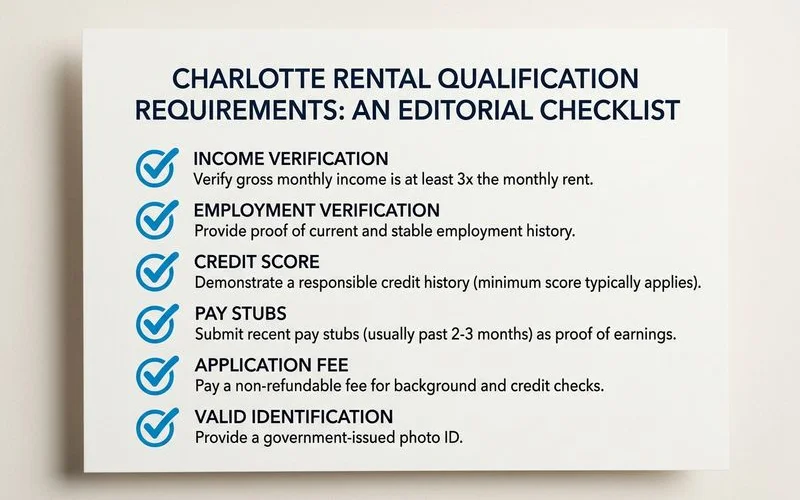
We highly recommend organizing your financial documents into a single digital folder before your apartment tours. You will need your paystubs, photo ID, and recent bank statements ready to upload immediately.
Our checklist below outlines exactly what you should prepare.
- Your two most recent paystubs or a signed offer letter on company letterhead.
- A valid, government-issued photo ID.
- Two years of tax returns if you rely on self-employed or 1099 income.
- Three to twelve months of complete bank statements to verify cash reserves.
- Your guarantor’s income documents and ID, if you require a co-signer.
- Complete pet documentation, including vaccination records and breed verification.
Our final piece of advice is to familiarize yourself with the overall process timeline to meet all charlotte apartment income requirements smoothly. For more on how the search timeline interacts with these rules, read our Charlotte apartment search timeline guide to plan your next step.
Common questions
What credit score do I need to rent in Charlotte?
Can I rent in Charlotte if I am self-employed?
Do I really need to earn 3x the rent?
Related guides
Apartment Locator vs. DIY Zillow Search in Charlotte
When a Charlotte locator beats Zillow, when DIY is fine, and the listing-freshness gap that costs renters time.
Are Charlotte Apartment Locators Actually Free?
How Charlotte apartment locators get paid by property management, and why the service is genuinely free for renters.
Charlotte Apartment Move-In Specials and Lease Incentives
Common Charlotte specials, net effective rent math, and when concessions signal a soft market versus a building problem.
Charlotte Apartment Search Timeline: How Long It Really Takes
Real Charlotte apartment search timeline: 2-4 week active search, 30-60 day lease windows, seasonal differences.
Ready to explore Apartment Locating?
A short conversation gets you a curated, lifestyle-first match.